for it knew now where it was going

3.3.23 ~ Sheep Farm
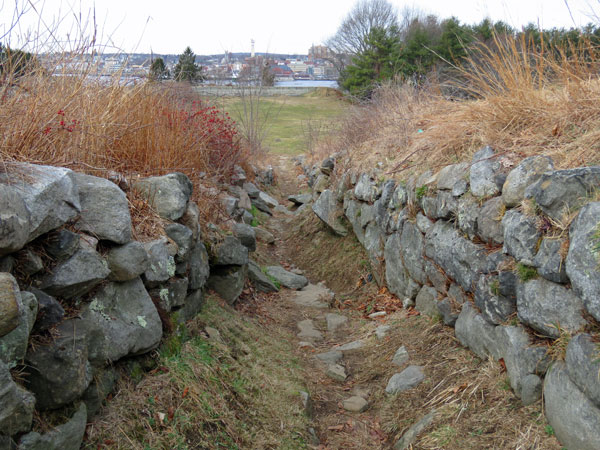
remains of 18th century grist mill dam

We first came to this open space property three years ago, at the beginning of the pandemic, and have been here many times since. Since we know we’re going to North Carolina in a few months this visit seemed special because we were well aware that we may never pass this way again.

standing on top of the dam looking upstream at Fort Hill Brook

A few days ago I spent some time sorting through my “walks” index file, pulling our favorite walks out of the rotation so we might visit them one last time before we go. Please forgive me for this very lengthy post. I want to save as many picture memories as possible!

the lower side of the dam

Usually we walk down to the waterfall and back up the hill, but this time we explored two side trails. First we walked upstream to the dam and walked out on it until the break which lets the brook through now. Then we hopped down off the dam and walked along the brook, getting a different view. With no leaves on the trees yet we could see a lot of the features in the woods.

dam in upper left quarter of picture
the break to restore the water flow is visible between the two dam sections
the dam is above the waterfall, behind me

By the time it came to the edge of the Forest, the stream had grown up, so that it was almost a river, and, being grown-up, it did not run and jump and sparkle along as it used to do when it was younger, but moved more slowly. For it knew now where it was going, and it said to itself, “There is no hurry. We shall get there some day.” But all the little streams higher up in the Forest went this way and that, quickly, eagerly, having so much to find out before it was too late.
~ A. A. Milne
(The House at Pooh Corner)

turning around, looking down over the waterfall to the footbridge below

We had never been at the top of the waterfall before. Tim even went out over it a little bit. My legs didn’t seem long enough to jump down where he was.

Tim at the top of the waterfall
from near the top of the waterfall

Then we found the main trail again and made our way down to below the waterfall. I was looking forward to getting pictures of an old tree with amazing roots extending into the brook.

an impressive glacial erratic on along the trail down to the waterfall
the back of the old tree with amazing roots
looking at the waterfall from the footbridge downstream
looking at the waterfall from the opposite side of the brook
the front of the old tree with amazing roots

After crossing the footbridge and getting the above pictures we decided to follow a new trail for a little bit. Sheep Farm South, a property adjoining this one, was purchased by the Groton Open Space Association in April 2021. New trails were created on it and linked to the existing ones on Sheep Farm. So we started down this one which passes by a large moss covered outcrop. It was taller than Tim.

there were many kinds of mosses on this large outcrop
a dripping icicle at the end of a branch sticking out of the outcrop
layers at the top of the outcrop
moss sprouting out of lichen
looking back along the outcrop
moss at eye level, a different perspective than usual

After we passed the outcrop we found a path that went up above it and walked through the woods a bit until we circled around and spotted the waterfall below us. I’m pretty sure the little vine below is partridge berry. It looks like the plant my brother-in-law identified for us at Connecticut College Arboretum, although not as lush looking.

partridge berry (Tim found it!)
waterfall viewed from up high above the outcrop
scorias spongiosa on beech leaves
scorias spongiosa coating beech twigs
one side of the old tree with amazing roots

Before crossing the footbridge I noticed a side view of the tree with the water hugging roots. It was a rough trip back up the long hill to the parking lot because Tim’s sciatica started acting up, but he made it. Perhaps we strayed a little too far this time but we did get to see a lot of things we haven’t seen before.

one side of broken tree with hole
other side of broken tree with hole

Packing boxes have arrived and I’m feeling overwhelmed with the enormity of the task before us but it was great spending a little time outside in the woods we will miss so much.

winter wanderings

1.22.23 ~ Leo Antonino Preserve, Groton, Connecticut
first brook crossing on the yellow trail

On a cold and cloudy winter morning we decided to explore a relatively new open space property pretty close to home. Leo Antonino Preserve was acquired by the Avalonia Land Conservancy in 2018. What a pleasant surprise we had as we meandered along the loop trail, so many twists and turns, ups and downs and bubbling brooks to cross. We haven’t had any accumulating snow this January, not even a coating. But the woods did smell like winter and the crisp cold air soon gave us rosy cheeks and runny noses.

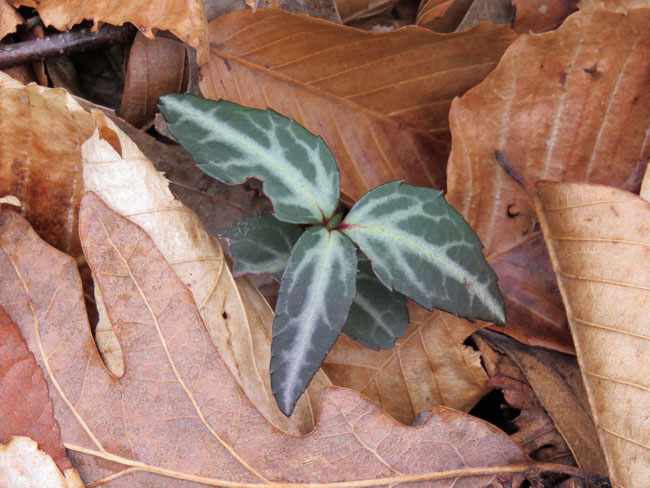
spotted wintergreen

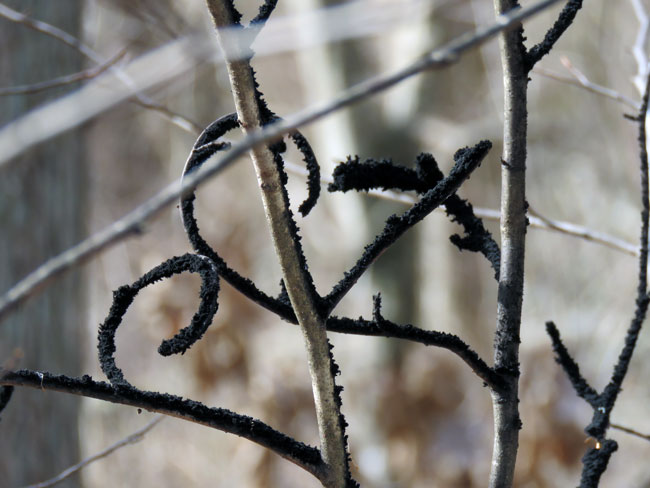
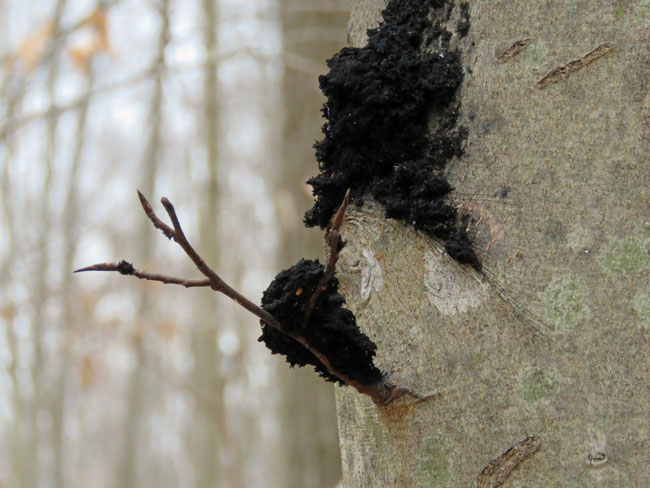
We were curious about this mysterious black stuff we saw on lots of the beech trees. Is it another symptom of beech bark disease?

The Leo Antonino Preserve is an unexpected tract of woods, wetland, rock outcroppings and erratics … The trail includes short sections of wide-open travel on packed earth and longer stretches of single-file trail that are rocky and rooty with elevation changes. The trail travels through areas of beech and oak and along vernal pools and active brooks. Erratics and upthrust sections of granite illustrate the geologic history of this section of Connecticut. Also illustrative of the history of this property, the yellow trail features the wreck of an old Chevy truck. The section of the yellow trail north of the Chevy is the most challenging with a scramble over a steep rocky ridge.
~ Avalonia Land Conservancy website

beech marcescence
very green mosses were everywhere

We made several crossings over a (or two?) brook. There were no bridges so we used the stepping stones, feeling grateful that we didn’t slip on the mosses!

another crossing
Tim left the trail, climbed the hill and then appeared from behind these erratics
yet another crossing
the wreck of an old Chevy truck
spotted wintergreen
a rusting metal circle hanging from a branch
ferns growing on top of a rock outcropping
lichen with moss
moss and lichen on different levels
sitting on top of a rocky ridge
American wintergreen
woodpecker work, I presume
???

Near the end of the trail we spotted these black lines on the path. I can’t help wondering if it’s the same black stuff we saw on the beeches…

I’ve been trying to be more selective and to include fewer pictures in my posts, but I had to make an exception for this one. When we started this hike I didn’t expect to take many pictures but it seemed like around every turn there was something interesting to notice. We’re looking forward to returning and trying the blue trail through these woods.

to the dinosaur place

4.1.22 ~ The Dinosaur Place
Oakdale, Connecticut

Kat’s last day with us turned out to be the season’s opening day at the Dinosaur Place. We were there when the doors opened and were the first visitors of the year! It was a chilly, dreary day and we were sprinkled with occasional raindrops, but we had fun in spite of the dismal weather.

First we spent a lot of time watching Kat play in the T-Rex Tower at Monty’s Playground. While we were waiting for the attendant to dry off its surfaces we played a couple of rounds of hide-and-seek with our granddaughter. I can’t remember the last time I played hide-and-seek!

Then we started walking on one of the trails, noticing along the way just some of the 50 life-sized dinosaurs lurking in the woods. Kat followed the signs to Carnivore Cavern.

The first time through Grandpa was brave enough to go with her. They came out smiling but Kat was covering her ears and reported that it was VERY LOUD in there.

Then Kat announced that she was going to go through all by her self, and she did. 🙂

Then we found the A-MAZE-asaurus maze, complete with an observation deck, from where Grandpa and Grammy watched Kat try to make her way through. After a bit we offered suggestions. Good thing she knew her right from her left.

The exit turned out to be a tunnel slide, with a dinosaur mouth to pass through. Too bad we couldn’t scramble over there fast enough to see her at the top or landing at the bottom.

Then we followed the map to find the secret treasure, a large piece of quartz in the ground.

And some petrified wood…

And then Kat wanted to return to Carnivore Cavern to take me through. So I got a picture of inside the entrance.

And then it got very dark and then the dinosaurs in there roared. I managed to get a picture of one of the beasts!

After we that we followed another trail. I couldn’t resist getting a picture of a skunk cabbage down in the swamp.

It’s fun seeing dinosaurs outside and getting a walk in the woods in at the same time.

Kat resting with Grandpa
waiting for Grandpa and noticing a lot of moss behind her
observing an abundance of mosses and lichens
the king of a rocky moss-covered mountain

On the way out Kat and her grandpa got some ice cream at The Village Ice Cream Shoppe, the first customers of the season. 😉 A perfect way to end the day. I hope we will be bringing Finn here, too, someday soon. 💙

It was almost nine years ago that Tim and I came here with our grandnephews, Julius and Dominic. I’m glad to have pictures and memories from that fun day, too. Pictures here. Those little guys are teenagers now!

four friendly goats

left to right, Chai, Crackers, Brie and Addie

Friday afternoon we had a lovely visit with four very charming goats, and their guardians, our friends Bob & Julie. The kids, Chai and Brie, are seven months old. We brought them a treat to eat, our holiday tree. 🌲 I had a blast with the photo op!

Bob and Chai

Chai loves to be held, although she’s starting to grow out of that a little.

Addie (above) is a fainting goat, which I learned from Bob is a goat with a hereditary condition that may cause her to stiffen or fall over when startled. Thankfully our presence didn’t startle her.

Tim makes a new friend

The fir tree was a hit, at least when the goat crackers weren’t being offered. 😉

Julie with Addie, Brie giving a kiss and Chai looking on

Clearly, Julie and her goats adore each other. It was so heartwarming to see. 💕

queen of the glacial erratic,
a quick detour on her way back to her barn

We walked with them back to their barn and got to see where they spend the night. What a treat and change of pace this visit was for us. Thank you, Bob & Julie!

for all who enjoy them

12.3.21 ~ Pequot Woods, Groton, Connecticut

This was my first visit to this 140-acre park in our town, but Tim hiked here many years ago with one of his friends. The Pequots were the first people living here before the English colonized what is now the town of Groton and the village of Mystic.

The infamous Pequot Massacre occurred near here on May 26, 1637.

Capt. John Mason led English, Mohegan, and Narragansett warriors in an attack on the main fortified Pequot village on the site of modern-day Mystic, Connecticut. The Pequot were surprised but quickly mounted a spirited defense that almost led to an English defeat. Realizing that he could not defeat the Pequot in the close quarters of the palisade, Mason ordered their wigwams set afire; some 400 Pequot men, women, and children were burned alive or slaughtered when they tried to escape.
~ Encyclopædia Britannica

There have been archaeological digs conducted in this park, unearthing musket balls and arrowheads. But there are no memorials here to tell the terrible story.

trailhead

After the English took over, this land was cleared for farming, and today there are plenty of stone walls remaining from those days, before farms were abandoned and many people went out west. The woods came back. Now we have hiking trails, wildlife viewing and an abandoned farm pond.

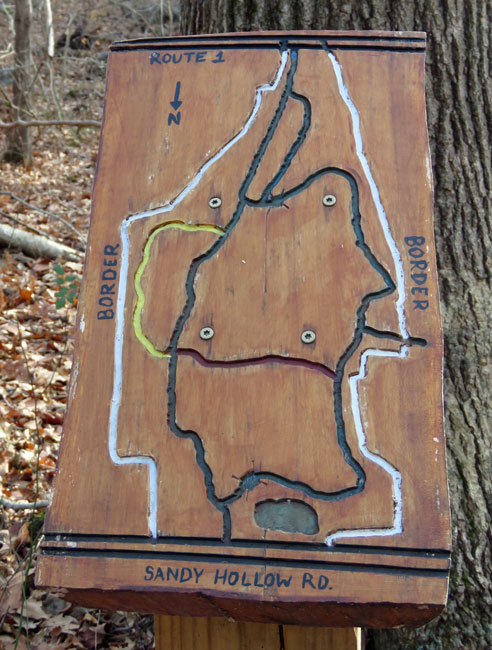
rough map carved in wood
the things this glacial erratic must have witnessed…

We gauge what we think is possible by what we know from experience, and our acceptance of scientific insights, in particular, is incremental, gained one experience at a time.
~ Bernd Heinrich
(Winter World: The Ingenuity of Animal Survival)

lots of stone walls
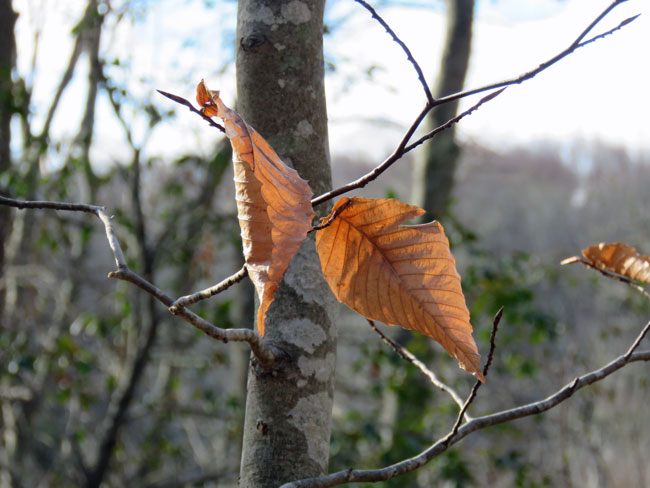
beech marcescence
interesting composition
shelf mushroom overlooking farm pond
colonial stone slab bridge
princess pine, first sighting since January
hummocks in the man-made farm pond
pair of mallards

It was a partly cloudy day, very cold, 41°F/5°C, with a feels-like temperature of 33°F/1°C, due to a moderate wind from the northwest. We had a nice conversation about cameras with the man in the next picture. He was trying to get a picture of the mallards, too, and wondered about my telescopic lens. His mother has a camera like mine and he’s considering getting one, too.

rescued greyhound bundled up for the cold
the uneven terrain
birdhouse in the middle of the farm pond
another delightful princess pine encounter

As far as coronavirus pandemic statistics go, I’ve decided to chronicle Connecticut’s positivity rate to make my tracking simpler. Looks like we’re headed into yet another surge. On the day of this walk our positivity rate jumped to 6.32%, the highest it’s been since last January.

a long narrow hilltop

11.9.21 ~ Candlewood Ridge, climbing up to the ridge

Last week we revisited Candlewood Ridge, where we had an amazing walk in April 2020. This day we didn’t get as far as we did the last time because Tim’s back and hip were acting up, but it was interesting to see how different things were with the passing of time.

For one thing, we remembered spotting a glacial erratic across the ravine but there was so much vegetation now that we couldn’t even see the other side of the ravine. So we walked north along the trail at the top of the ridge and spotted an erratic that Tim had stood next to last time. The brush was so thick we couldn’t get close to it.

I put a picture of Tim by it last time below. Nature is always changing the scenery!

4.17.20 ~ Tim with the same boulder a year and seven months ago
so many orbs

After we got to the erratic above we decided to turn back. But when we got to the side trail to go back down to the car I spotted another erratic farther south on the ridge, in the direction we hadn’t taken last time. So we found a spot for Tim to sit and rest and I took off on my own to get some pictures. Little did I know I was in for a good scare.

front of the huge glacial erratic

I took pictures of the front and then went around to the back of it and took some more.

back of the huge glacial erratic

As I was taking pictures of the back I became aware of the sound of panting approaching from behind me pretty quickly. I froze, and before I knew it a loose dog appeared. I have an intense fear of large and medium size dogs so it was all I could do to keep myself from panicking. I forced myself to remember Cesar Millan’s advice, “no touch, no talk, no eye contact.” I was glad I had the camera in my hands, for some reason it made me feel less vulnerable. The dog seemed uninterested in me and kept a respectable distance, although it did circle around me a few times.

side of the huge glacial erratic

I moved to the side of the erratic and kept taking pictures, ignoring the dog. I didn’t realize he got in two of the pictures! Then I decided to start walking back to Tim, followed by the dog. After I got within earshot I called him, calmly, and asked him to come to me. Meanwhile another dog came along the path, and then about the time Tim and I met the dogs’ owner came along, too. Phew! She continued north on the trail and we took the path down to the car. My heart was pounding.

path down from the ridge

Instead of heading straight home we took another autumn drive and wound up near the Mystic River. Mallard photo op!

And berry tangles!

Like a tide it comes in,
wave after wave of foliage and fruit,
the nurtured and the wild,
out of the light to this shore.
In its extravagance we shape
the strenuous outline of enough.

~ Wendell Berry
(The Arrival)

For some reason the berries and twigs made me think of calico cloth or old-fashioned wallpaper. Autumn lingers…

tipping rock

2.24.21 ~ Hewitt Farm, North Stonington, Connecticut

Because of the winter storms we hadn’t had a real walk in the woods in over a month. “Get out there!” my favorite TV weatherman advised on Wednesday morning. We opened the door and the birds were singing and it felt like a spring day at 45°F (7°C). Most of the snow had melted. So we headed out to a new park for us, the Hewitt Farm in North Stonington.

This 104-acre park and recreation area was purchased by the Town of North Stonington in 2008 for the enjoyment of its residents and visitors to the region. The property consists of forests, fields, wetlands and streams; more than a mile of hiking trails, including the town’s Bicentennial Trail; the Shunock River; 3.5-acre Lower Hewitt Pond and dam; and several structures. The dam originally provided water-power to John Dean Gallup’s woolen mill located nearby.
~ Hewitt Farm Trail Map

a preview of the bigger rock to come

We took the Bicentennial Trail. It felt so good to be outside with a just a sweatshirt and no gloves needed! We walked for an hour and a half, up a hill to Tipping Rock, a huge glacier erratic that didn’t disappoint. From the top of the hill we could see the wooded landscape 360° all around us. But there was also lots to see along the way.

moss texture
another glacial erratic with a different energy
interesting root formation

For most of us knowledge comes largely through sight, yet we look about with such unseeing eyes that we are partially blind. One way to open your eyes is to ask yourself, “What if I had never seen this before? What if I knew I would never see it again?”
~ Rachel Carson
(The Sense of Wonder)

perhaps the largest burl we’ve encountered

Not sure how long the trail would be we were thinking of turning back but then we saw the sign. So we pressed on up the hill…

first glimpse (telephoto lens)
what? could that be a ladder?
yes, indeed
no, we do not “do” ladders!
photo by Tim

After much oohing and aahing we headed back down the hill. It was a lot easier and faster than climbing up, but we still paused to see a lot of nature’s delights.

pincushion moss, I think
another interesting root formation

About half way down we heard the delighful sounds of excited children approaching. Two mothers with two babies and four little ones between them were coming up the trail so we took our usual six-feet-off-the-trail position as they passed. We exchanged pleasant greetings. They were wondering about the ladder…

remnants of autumn and winter

We were so happy to be out and about, as much as is possible, during the pandemic. Tim got his first shot on the 17th. Next one scheduled for March 17. My age group opens up on Monday but it may take a while to get an appointment because there are a lot more people in my age group than there are in Tim’s.

where a battle has been fought

1.19.21 ~ Fort Griswold Battlefield State Park
Groton, Connecticut

Near the end of December we found the graves of a couple of Revolutionary War soldiers on a walk in Stoddard Hill State Park. Debbie, one of my readers, mentioned that they don’t have graves that old where she lives in Illinois. So, although I much prefer nature walks, I decided we could change things up a bit and take a history walk. Because of Debbie’s comment I have a new appreciation for the historic Battle of Groton Heights that took place right here in my town. (Link is for history buffs.)

DEFENDERS OF FORT GRISWOLD • SEPT • 6th 1781•

This is the historic site where, on September 6, 1781, British Forces, commanded by the infamous Benedict Arnold, captured the Fort and massacred 88 of the 165 defenders stationed there. The Ebenezer Avery House which sheltered the wounded after the battle has been restored on the grounds. A Revolutionary War museum also depicts the era. Fort Griswold was designated as a state park in 1953.
~ Fort Griswold Battlefield State Park website

Col. Ledyard memorial

There is some doubt about the details of this story. The shirt and vest Col. Ledyard was wearing when he was killed had tears in the side, suggesting a bayonet wound is what caused his death, not his own sword in the hands of a British officer.

parade ground in the fort
dried seed pods on the wall

Critical acumen is exerted in vain to uncover the past; the past cannot be presented; we cannot know what we are not. But one veil hangs over past, present, and future, and it is the province of the historian to find out, not what was, but what is. Where a battle has been fought, you will find nothing but the bones of men and beasts; where a battle is being fought, there are hearts beating.
~ Henry David Thoreau
(A Week on the Concord & Merrimack Rivers)

dried seed pods on the wall
a door in the fort wall
looking down at the lower battery, seen from the new viewing platform
USCGC Eagle docked across the Thames River at Fort Trumbull in New London

The 295-foot Barque Eagle is the flagship of the U.S. Coast Guard. She serves as a training vessel for cadets at the Coast Guard Academy and candidates from the Officer Candidate School. The Eagle is the only active-duty sailing vessel in America’s military, and one of only two commissioned sailing vessels, along with the USS Constitution.
~ US Coast Guard Academy website

Tim at entrance to the tunnel through the wall of the fort
Tim at exit of the tunnel through the wall of the fort

From the tunnel we followed a trench down the hill. The trench hid the soldiers from enemy fire as they moved between the fort and the lower battery.

view from the trench
looking down the trench, it turns to the left ahead
after the turn, getting closer to the end
powder magazine, built in 1843
looking up at the fort, the trench zig zags to the right

Off to the side on the lower battery is the restored Ebenezer Avery house. It was moved to this location from a nearby street in 1971.

In the old times, women did not get their lives written, though I don’t doubt many of them were much better worth writing than the men’s.
~ Harriet Beecher Stowe
(The Pearl of Orr’s Island: A Story of the Coast of Maine)

Anna Warner Bailey

Sometimes I think that historical houses should be named after the wives and daughters who lived in them, to honor them, as they very likely spent more time working there than the men who were out and about in the world.

But on a plaque outside this house I found a picture of Anna Warner Bailey (1758-1851) and the note that she was one of the first women to tend to the wounded after the battle. When I got home I found this online: Our Petticoat Heroine by Carol Kimball

We’ll have to wait until the pandemic is over before we can tour the house. I discovered a bit of synchronicity, we happened to be visiting this place on the 170th anniversary of Anna Warner “Mother” Bailey’s death. And there is a house named for her close by, where she had lived.

entrance gate and Groton Monument, seen from lower battery

The Groton Monument was built between 1826 and 1830, and is the oldest monument of its type in the country. Built of granite quarried locally, the Monument stands 135 feet tall with 166 steps.
~ Fort Griswold Battlefield website

We will also have to wait until the pandemic is over before we can tour the monument and small museum.

When I was preparing this post I noticed I already had a category for Fort Griswold Battlefield State Park. With another nod to synchronicity, it turns out Tim & I visited the fort nine years ago, almost to the day! The trench looks a little different nine years later. We had climbed up on the fort wall, which is no longer allowed. They have installed a viewing platform on the wall sometime in the past nine years. My, how things keep changing… The views of the river and city below are amazing. My old post: Fort Griswold Battlefield

off the beaten path

12.29.20 ~ cute little sapling
Connecticut College Arboretum, New London, Connecticut

Tuesday we donned our masks and warm layers and headed over to the Arboretum to meet my sister and her husband for our first in-person visit since the pandemic started in March, unless you count video calls and quick verbal exchanges from our balcony to the parking lot. We had planned a “safe” outdoor meeting like this to celebrate Thanksgiving and then Christmas, but rain had spoiled our plans for both days.

Beverly & John, geologist and botanist, know the natural areas of the Arboretum like the backs of their hands so I was anticipating a wonderful guided tour, off the beaten path. It did feel awfully unnatural, though, keeping six feet apart behind masks for a couple of hours, but we pulled if off. It was so good being with them again. We explored the Bolleswood Natural Area.

partridge berry

Partridge Berry is a native perennial, a small, woody, trailing vine with 6 to 12 inch, slender, trailing stems that does not climb but lays prostrate on the forest floor. The trailing stems root at nodes which come in contact with the forest surface and may spread into colonies several yards across. … The fruits are tasteless and generally survive through winter and into the following spring. Birds are the primary consumer of these fruits and the subsequent distribution of seeds.
~ US Forest Service website

Knowing about our recent fascination with glacial erratics, Beverly had a surprise for us, a huge one! Our first glimpse of it is below…

first side
front side

It looks like that rotting tree grew up there and was then snapped down in a storm. But it also looks like humans have moved some wood around, making it look like the wood is holding up the stone, but it’s not. It’s resting on other erratics underground.

other side (Tim is 5’8″)
a close-up from the back
a peek underneath ~ two orbs!

After marveling over this erratic’s size and its precarious perch we continued on. Sometimes there was so much moss along the path it reminded me of a forest in Ireland.

And we finally came to a flooded bog. (The drought is definitely over.) It was beautiful with bits of moss, autumn leaves under the water, partial sheets of thin ice, sticks, and a few remaining plants and grasses.

And then John pointed out a carnivorous plant…

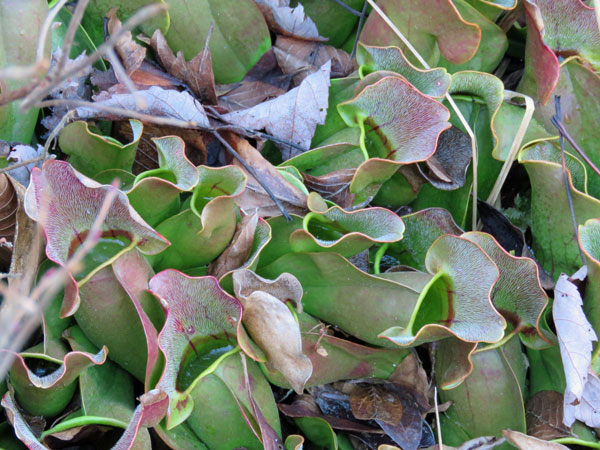
pitcher plant hidden in leaves

The pitchers trap and digesting flying and crawling insects, making the species one of the few carnivorous plants in North America. The hollow pitchers fill naturally with rainwater. The pitchers also have broad lips where insects land. The insects crawl into the pitcher, where stiff, downward pointing hairs prevent them from leaving. Anectdoctal evidence suggests pitchers capture less than one percent of the flies that venture into their traps, but a few insects eventually fall into the water at the base of the pitcher, where digestive enzymes secreted by the plant release the nutrients within the insects. Eventually, the nutrients are absorbed by the plant, which supplements the nutrients absorbed by the roots.
~ US Forest Service website

pitcher plant

On our way out of the Arboretum we saw…

winterberry aka black alder
oyster mushroom, thanks to Larisa’s friend for the id

It was sad to say good-bye but we were getting cold and so made our way home to some hot tea. Curled up under our blankets, we put on some music and our happy holiday hearth DVD. Very cozy after having rosy cheeks from the chilly air. Maybe we’ll do this again — hopefully soon.