Saturday afternoon I opened box #9 of the 14 family history boxes I’m going through. In it I found this magazine page, torn from the August 1915 issue of Harper’s Bazaar. The portrait sketch of Miss Helen Hamilton was done by Harrison Fisher, an American artist born in 1875 in Brooklyn, New York, known for his illustrations of women.
Turns out Helen Hamilton was a second cousin of Tim’s grandmother, Allegra Hamilton. They were great-granddaughters of Benjamin Hamilton (1792-1880). Helen was about 19 years old in this sketch. She went on to marry Frederick Vincent and Allegra married Tim’s grandfather, Karl Rodgers. I wonder how well they knew each other, as Helen lived in California and Allegra lived in New York. I don’t know most of my second cousins.
This box is densely packed with newspaper clippings, correspondence, and research notes from Tim’s great-grandmother, Gertrude Hubbard. It’s going to take me a long time to get it organized! That’s okay, though, I’ve got a long hot summer ahead of me.
Meanwhile, I’ve been enjoying the cardinals singing in the wax myrtle tree outside my kitchen window every morning.
Today we’ve been married for 48 years, or as Tim is saying, it is our four dozen anniversary. 🎕 It was a small, down-to-earth and unpretentious wedding, outside, of course, in the garden of a justice of the peace.
Beverly & Barbara
My sister was my maid-of-honor, shown here at the small reception my parents hosted in their back yard. As I’ve mentioned before, my little sister grew up to be taller than me. For a couple of years we were the same height and were often mistaken for twins.
I found it!
While sorting through all our stuff last month I came across my mini wedding album. I hadn’t seen it for years and was happy to discover that it hadn’t been lost as I had assumed.
Tim often introduces me as his first wife, which still makes me smile. His sense of humor is one of the many things I still love about him, after all these dozens of years. 💕
Tropical Storm Elsa cleared up in time for us to have our supper down at the beach. Didn’t see any storm damage, although other parts of Connecticut got some flash flooding. We had 4 inches of rain. The winds weren’t too bad but it was still pretty breezy down by the water. The wildflowers on the rocks looked freshly showered.
We had two gulls to keep us company. They waited politely and posed for pictures but never got a bit of food from us.
ring-billed gull
herring gull
herring gull feet
After we ate we took a walk over to look at the island where we saw the great blue heron the other day but he wasn’t there. Instead, we saw a Canada goose hanging out with the American oystercatchers. If only I could get closer!
And as we passed by the song sparrow’s thicket we saw one of them. When he faced the sun and the wind he looked fine, and when he turned and faced away from the wind his feathers ruffled.
It was good to get out of the house. Still trying to wrap our minds around the latest COVID-19 news, that 4 million people have died of it worldwide. (Probably many more than that.) Even though things seem almost back to normal around here, the fact is that most of the world is still in a very precarious situation.
We worked on a jigsaw puzzle during the storm… Now it’s back to the heat and humidity and thunderstorms…
On Friday we tried the new-to-us park again and this time there was noone in sight at the trailhead – yay! This property was acquired in 2013. After crossing a little bridge over a brook we climbed up to Candlewood Ridge and enjoyed looking up and down the ravine on the other side. We followed the trails for over an hour. Tim’s legs and back did much better and I’m wondering if walking on the earth is better for him than walking on hard surfaces like pavement and concrete.
4.17.20 ~ crossing a stream, skunk cabbage
Candlewood Ridge is part of a critical large block of diverse wildlife habitats highlighted on the State of CT Natural Diversity Database maps: early successional forest, oak-hemlock-hickory upland forest, native shrubby and grassy habitat, forested peatlands, kettle type bogs, tussock sedge, poor fens, multiple seeps, several Tier I vernal pools, and streams. ~ Groton Open Space Association website
4.17.20 ~ almost to the top of the ridge
4.17.20 ~ a very tall bare tree trunk
4.17.20 ~ taken with telephoto lens, a huge boulder across the ravine
The songs of birds filled the air! A chickadee scolded us from a branch so close I could have reached out and touched it. But he flew off before I could lift the camera…
4.17.20 ~ the glacial erratics found here were fewer and more widely spaced than the ones we saw in Ledyard’s Glacial Park
We followed the trail north along the top of the ridge and then it slowly went downhill until we reached a bridge across another stream. From studying the map it looks like the two unnamed streams join and then eventually merge with Haley Brook.
4.17.20 ~ second bridge on the trail
4.17.20 ~ a squirrel nest
4.17.20 ~ the little stream4.17.20 ~ vernal pool?
All the green under the water (above) looked to me like drowning princess pines.
4.17.20 ~ taken with telephoto lens across the sand plain
4.17.20 ~ the sand plain with glacial erratic in the distance
We turned around here without crossing the plain and climbing that ridge!
4.17.20 ~ might these be the candlewood pines (pitch pines) the ridge is named for?
4.17.20 ~ pussy willows
4.17.20 ~ one tree favors moss, the other lichens
Crossing the stream on the return trip, a tiny bright spot of yellow-orange caught my eye. What is it??? I used the telephoto lens to get a picture and tried to identify it when I got home. Hope I got it right. A mushroom.
Just before crossing the second stream on the return walk, a garter snake slithered across the path right in front of me. Startled, I then spotted him trying to hide in the leaves. Don’t think I’ve seen a garter snake since I was a child, sunning themselves on the stone walls around the garden.
4.17.20 ~ hiding garter snake
It was a wonderful walk!
4.17.20 ~ beauty in a vernal pool
I go to Nature to be soothed and healed, and to have my senses put in tune once more. ~ John Burroughs (The Gospel of Nature)
2.4.18 ~ Caher Conor, Mount Eagle, Kerry, Ireland not sure if the 2,000 BC date is accurate ~ other sources suggest the 12th century
Sunday happened to be Imbolc, Groundhog Day, Candlemas or Brigid’s Day, about halfway between the winter solstice and the spring equinox. It marks the beginning of spring, which I now see comes a lot sooner in Ireland than it does in New England. Our first stop was at these fascinating beehive huts.
the canine proprietor greeting us was eager to sell us tickets
the ticket booth was a bit run down but Larisa found him friendly enough
Dima, Katherine and Tim had already started the 2-minute walk up the mountain path
the path narrows
stone wall path boundary
looking back down at the sea behind us
I loved the lichens on the stones and the little green mosses and plants
Also known as the Fahan Beehive Huts, Caher Conor (Cathair na gConchuireach) is located on the south side of Mount Eagle west of Dingle. The complex consists of five structures.
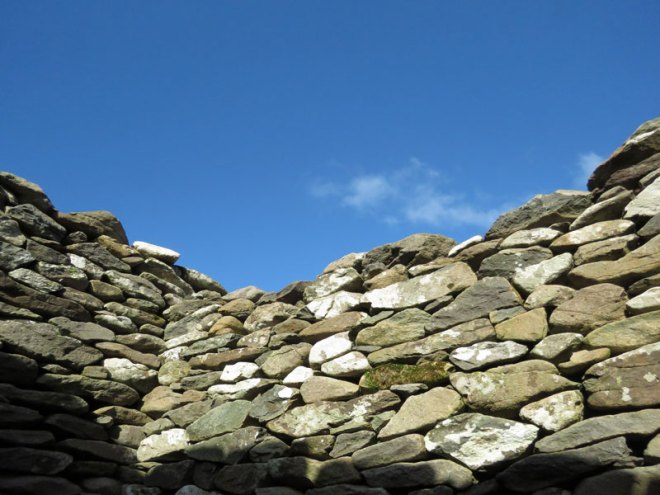
The clochan (beehive huts) in Caher Conor were probably single family dwellings and were attached to each other with a doorway leading from one to the other. They were built in the form of a circle of successive strata of stone, each stratum lying a little closer to the center than the one beneath and so on up to a small aperture at the top that could be closed with a single small flagstone or capstone. No mortar was used in building, which is called corbelling.
The hillside at one time had over 400 of these drystone, corbelled huts surviving, prompting one antiquarian in the 19th century to refer to the area as the “City of Fahan”. Dating the huts is difficult because the skill of corbelling has been used in Newgrange (3100 B.C.) and as recently as the 1950s. The huts at Fahan along the Slea Head Drive may well date to the 12th Century when the incoming Normans forced the Irish off the good land and out to the periphery of the Dingle Peninsula.
orbs ~ I found the one with the bright center very interesting
it was so cold that Katherine finally relented and put her coat on ~ notice the pink plastic spoon in her hand ~ it was with her most of the day
Larisa and a gorgeous view
Dima and another view
this cross would make more sense being here if the wall was built in the 12th century
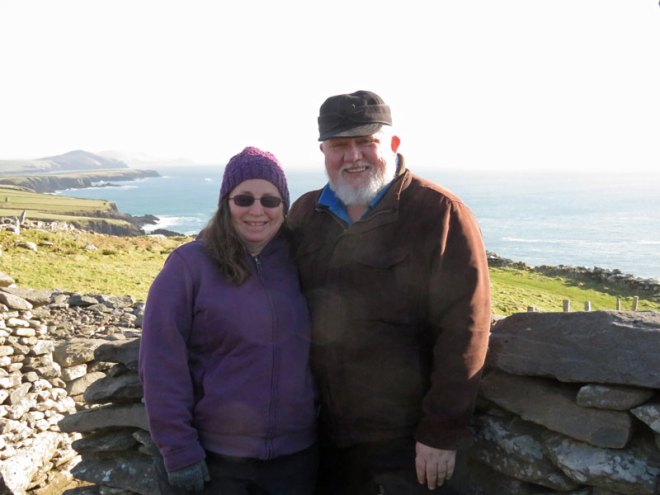
Barbara & Tim with orbs ~ Larisa knit the hat from Irish wool ~ at first she let me borrow it but then she gave it to me ~ now I have wool hats from Ireland and Norway!
I think Ireland may have even more stones than New England does!
coming around a corner
the walk back down to the parking lot
the canine proprietor keeping tabs on our departure
a door on a nearby building
the side of the same building, set well into the steep mountainside
the narrow, one-lane road between the entrance and the tiny parking lot
view looking down from the parking lot ~ yikes!
It was good to get warmed up in the car and drive off for our next destination.
2.4.18 ~ view from The Plough Bed & Breakfast, Ventry, Kerry, Ireland morning light and the moon
After our long afternoon at Coumeenoole Beach we found our bed and breakfast, The Plough. The hostess, Beatrice, made us feel right at home. When we got warmed up and settled, we headed out again for dinner at Lord Baker’s, Dingle’s oldest gastro pub and largest restaurant. Tim & I had one of that night’s specials, Slow Roast Shank of Kerry Lamb & Red Wine Sauce. (local and grass-fed lamb) It was so delicious that we are still talking about it!
When we returned to our B&B I was feeling chilled so Beatrice warmed up a hot water bottle with a faux fur covering to take to bed with me. I warmed up quickly and slept very soundly. 🙂
Sunday morning Tim & I woke up before the others and took a morning walk. The surrounding scenery was soothing and pastoral. We were overlooking Ventry Harbour and the moon was still in the sky.
some whimsy in the garden
When we returned for breakfast we had a pleasant surprise. The first thing offered was porridge and was it ever tasty! Beatrice said the “secret” ingredients were local, sweet cream and a little shot of Bailey’s. 🙂 Then we had a choice of various egg, ham, and sausage breakfast combinations.
beautiful stone wall and daffodils!
the plough
Ventry Harbour
daffodils in February!
a very cold me!
whimsy at the front door
reading nook
I loved the pillows Beatrice used in her sitting room! This was our first time ever staying at a bed & breakfast ~ thank you Larisa & Dima for the special treat!!!
deer pillow
woodsy pillow
robin pillow
We had a long day ahead of us and so we were then off for the next adventures.
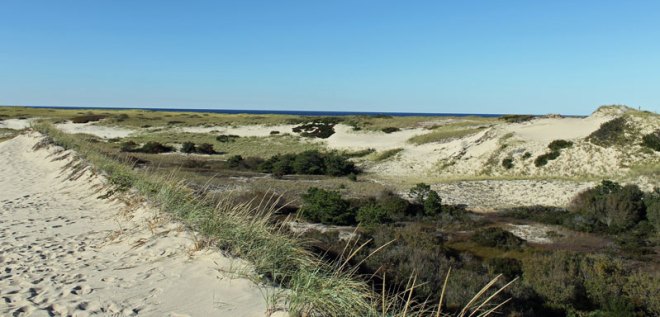
Province Lands 10.10.15 ~ Provincetown, Massachusetts
This is another of those strangely potent places. Everyone I know who has spent any time on the dune agrees that there’s, well, something there, though outwardly it is neither more nor less than an enormous arc of sand cutting across the sky. ~ Michael Cunningham (Land’s End: A Walk in Provincetown)
Almost every time we go to Provincetown we go on one of Art’s Dune Tours to see the Province Lands sand dunes of Cape Cod National Seashore. In the past part of the tour took us down on the beach but we couldn’t do that this time due to severe beach erosion caused by storms the past couple of winters. So we had to be satisfied with exploring the dunes themselves. Unfortunately we weren’t able to book a sunset tour – those have been our favorites over the years.
If I die tomorrow, Provincetown is where I’d want my ashes scattered. Who knows why we fall in love, with places or people, with objects or ideas? Thirty centuries of literature haven’t begun to solve the mystery; nor have they in any way slaked our interest in it. Provincetown is a mysterious place, and those of us who love it tend to do so with a peculiar, inscrutable intensity. ~ Michael Cunningham (Land’s End: A Walk in Provincetown)
Pilgrim Monument, in the distance, is 252 feet high
a little tourist from Switzerland
words left on a shingle in the dune
Our guide kept showing us where the sands have been shifting in recent years, impressing on us the endless flow of nature. How strange that while present there, time seems to stand still, if only for a moment.
In April of 1966, the three third grade classes in my elementary school took part in the celebration of Arbor Day. Storrs Grammar School no longer exists, but the building is now called the Audrey P. Beck Municipal Building, serving as the town hall for Mansfield, Connecticut. On the corner of the property, near the junction of South Eagleville Rd. and Storrs Rd., stand three trees which were planted by me and my classmates. A solemn and serious child, this made a big impression on me. Each class had filled a glass jar with notes to the future from each child in the class, and each class planted its glass full of notes deep under the ground with the roots of its tree.
Every time I drive by these three trees, which is every time I go to visit my dad, I think of that day and wonder if those jars will ever be unearthed… Why are certain things remembered so vividly and others so soon forgotten?
Arbor Day as a holiday was created by a man named J. Sterling Morton and was first celebrated on April 10, 1872. It was estimated that a million trees were planted for the occasion, nationwide. I wonder if Earth Day, which got started in 1970, has eclipsed interest in this much older holiday. Certainly we can’t have too many reminders about honoring the lives of our dear friends, the trees.
The Arbor Day Foundation has an interesting history, click here. And suggestions for marking the day, click here.
A lifting gale of sea-gulls followed them; slim yachts of the element, Natural growths of the sky, no wonder Light wings to leave sea; but those grave weights toil, and are powerful. ~ Robinson Jeffers (Pelicans)
In this world you’ve a soul for a compass And a heart for a pair of wings There’s a star on the far horizon Rising bright in an azure sky For the rest of the time that you’re given Why walk when you can fly? ~ Mary Chapin Carpenter ♫ (Why Walk When You Can Fly) ♫