I mourn no more my vanished years: Beneath a tender rain, An April rain of smiles and tears, My heart is young again.
The west-winds blow, and, singing low, I hear the glad streams run; The windows of my soul I throw Wide open to the sun.
No longer forward nor behind I look in hope or fear; But, grateful, take the good I find, The best of now and here.
~ John Greenleaf Whittier (My Psalm)
We now have 63 confirmed cases of COVID-19 in our town. I cannot find statistics on the number of deaths, except by county. For my own future reference, our county (New London) has 498 confirmed cases and 31 deaths.
One model mentioned on NPR thinks June 9 would be a safe date to ease social distancing in Connecticut. Somehow, with these numbers still rising, I don’t think I will be ready to leave my bubble by then.
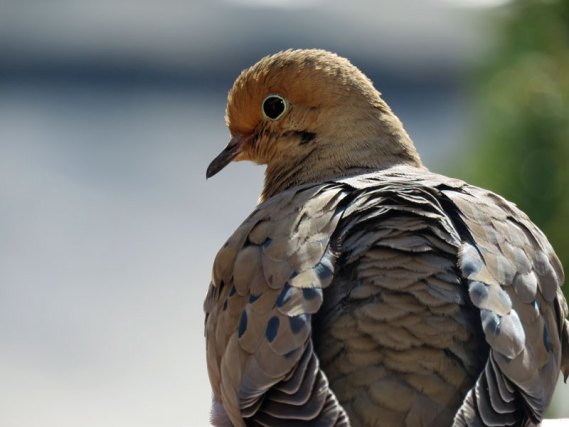
Mourning doves have been visiting me off and on since my mother died twenty-eight years ago. They seem to arrive when I could use a little encouragement. When I used to garden one would often sit near me and watch me as I worked. Once one walked with me all the way from my garden to the swimming pool in our complex. Lately one comes to sit on the balcony almost daily and coos for as long as an hour at a time. I find her company very comforting.
Sunday morning I decided to try to photograph her through the sliding glass doors and was thrilled with the results. She didn’t seem to mind posing. I know they are plain birds, but that’s exactly why I find them so beautiful! I love them the same way I love my gulls.
In this sad world of ours, sorrow comes to all; and, to the young, it comes with bitterest agony, because it takes them unawares. The older have learned to ever expect it. ~ Abraham Lincoln (Letter to Fanny McCullough, December 23, 1862)
When I first read the Lincoln quote six years ago, after my father died, I remember thinking how true it was. When my mother died I was so young it came as a terrible blow and I needed therapy to work through the grief. By the time my father died it was no longer such a shocking experience. I deeply felt the pain of loss, but it wasn’t unexpected.
We now have 36 confirmed cases of COVID-19 in our town. There are moments I feel terribly anxious about this. It’s starting to sink in that it may be be many months or even more than a year before it will be safe to visit our grandchildren again. As it stands now, I don’t think I will feel free from danger before there is a vaccine. But we are trying to make the best of it and even find a sense of humor at times.
I find myself wondering how my parents would respond to the coronavirus pandemic. I imagine they would probably be just as blindsided as the rest of humanity. But since Mother Nature sees fit to send me such a sweet comforter as this lovely mourning dove I will stay grateful.
It’s not true that life is one damn thing after another — it’s one damn thing over and over. ~ Edna St. Vincent Millay (Letter to Arthur Davison Ficke, October 24, 1930)
this might be my favorite pose
The Millay quote has been one of my favorites for a long time. It amuses me and helps me to laugh at the ironic situations I think I find myself in. The coronavirus pandemic feels unprecedented, and perhaps it is in my lifetime, but not at all in the history of the world.
In the trilogy Kristin Lavransdatter by Sigrid Undset, the protagonist, Kristin, dies from the Black Death at the end. It’s one thing to read about plague statistics in history books, quite another to experience what it must have been like while reading the words of an excellent storyteller. It comforts me to know others have felt the same fear.
Being a highly sensitive child, whenever I would lament about the sad things happening in the world my father would sigh and advise me, “‘Twas ever thus.” When my mother was dying of cancer and my heart ached for her suffering he would gently remind me that “every creature struggles for life.” He was a naturalist and scientist who taught us compassion for animals and people, but also prepared us for loss. Whenever one of our pets died he would tell us to “remember the good times.” I am so grateful for the lessons he taught me.
showing off her feathers
‘Twas ever thus — from childhood’s hour I’ve seen my fondest hopes decay, I never loved a tree or flower but ’twas the first to fade away. ~ Charles Dickens (The Old Curiosity Shop)
“Herding Sheep in a Winter Landscape at Sunset” by Joseph Farquharson
Nothing there is that does not love the sun. It gives us warmth and life; it melts the bitter snow and ice of winter; it makes plants grow and flowers bloom. It gives us the long summer evenings, when darkness never comes. It saves us from the bitter days of midwinter, when the darkness is broken only for a handful of hours and the sun is cold and distant, like the pale eye of a corpse. ~ Neil Gaiman (Norse Mythology)
The Things that never can come back, are several — Childhood — some forms of Hope — the Dead — Though Joys — like Men — may sometimes make a Journey — And still abide — We do not mourn for Traveler, or Sailor, Their Routes are fair — But think enlarged of all that they will tell us Returning here — “Here”! There are typic “Heres” — Foretold Locations — The Spirit does not stand — Himself — at whatsoever Fathom His Native Land — ~ Emily Dickinson (The Poems of Emily Dickinson, #1564)
It is the life of the crystal, the architect of the flake, the fire of the frost, the soul of the sunbeam. This crisp winter air is full of it. ~ John Burroughs (Winter Sunshine)
Lift up your countenance! The sun’s growing higher. The light’s pitching camp on free mountain tops. That hope you conceived on the winter solstice stands like a new day’s dawning in your eyes shining forth. ~ Einar Skjæraasen (Seasons)
The human heart has hidden treasures, In secret kept, in silence sealed;- The thoughts, the hopes, the dreams, the pleasures, Whose charms were broken if revealed. ~ Charlotte Brontë (The Poems of Charlotte Brontë [Currer Bell])